Exports
Starting an Export Business from India: First Steps
By ATTPL Consultancy Marketplace Editorial Team · · 3 min read
How Indian MSMEs can start exporting: IEC, RCMC, GST and LUT, product and market selection, pricing, documentation, payments and support schemes.

Why exports are worth exploring
Exports let a business reach larger markets, spread risk across countries and often earn better margins. Rajasthan already exports handicrafts, textiles, gems and jewellery, stone, engineering goods and agricultural products. Many small firms supply exporters indirectly; with some preparation, they can sell abroad on their own.
This guide outlines the first steps. Rules and schemes change, so confirm details on official portals or with a qualified advisor.
Core registrations
- Importer Exporter Code (IEC): issued online by the Directorate General of Foreign Trade (DGFT); required for most exports.
- GST registration and a Letter of Undertaking (LUT) to export without paying IGST, or the refund route.
- Registration-cum-Membership Certificate (RCMC) from the relevant export promotion council, needed to claim certain benefits.
- Current account with a bank authorised to handle foreign exchange.
- Product-specific approvals where required, for example for food, drugs or certain chemicals.
Our guide to GST registration in Jaipur covers the GST side.
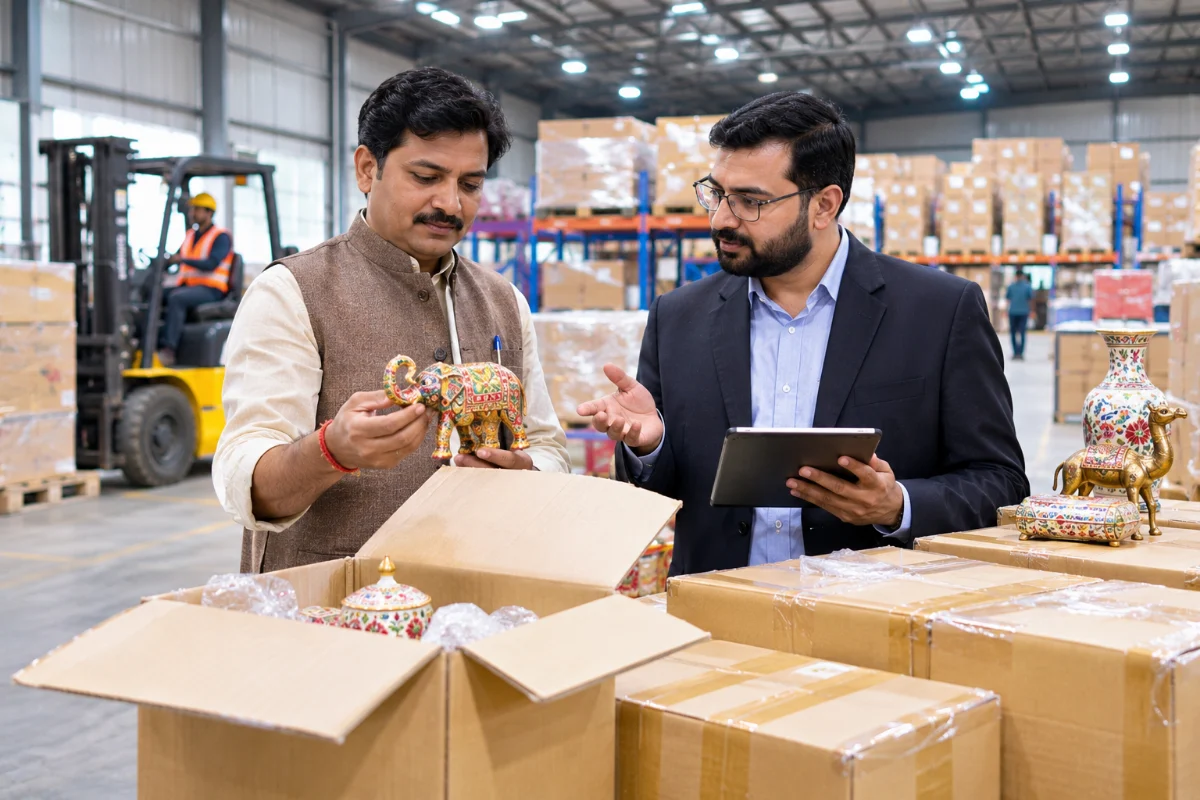
Choose products and markets carefully
Start with products you already make well and can supply consistently. Use trade data, buyer enquiries and embassy and export council reports to shortlist markets. Check import duties, standards, labelling and certification requirements in each target country. Quality certifications such as ISO can build trust with foreign buyers; see ISO certification for MSMEs.
Pricing and terms of trade
- Understand Incoterms such as EXW, FOB and CIF — they decide who pays for freight, insurance and risk at each stage.
- Include packing, inland transport, port charges, freight, insurance, bank charges and currency risk in your price.
- Agree payment terms clearly: advance payment, letter of credit or documents against payment, depending on trust and risk.
- Consider export credit insurance for open-account sales.
Documentation basics
Typical documents include the commercial invoice, packing list, shipping bill, bill of lading or airway bill, certificate of origin and any product certificates. A good customs broker and freight forwarder save time and mistakes, especially for the first shipments.
Support for exporters
Government schemes and export promotion councils offer market information, buyer–seller meets, trade fair support and, in some cases, duty remission benefits. District-level export facilitation can help new exporters. Finance is available through pre-shipment and post-shipment credit from banks; ATTPL Finance can explain working capital options. Contracts with foreign buyers deserve legal review; ATTPL Legal can help.
For a broader plan, see our article on setting up a business in India for foreign companies and how to find and apply for government subsidies.
Common mistakes new exporters make
Many first-time exporters face avoidable problems. Knowing them in advance saves money and reputation.
- Quoting prices without including all logistics, bank and documentation costs.
- Shipping without checking the buyer's credibility or securing payment terms.
- Ignoring product standards, labelling or packaging rules of the destination country.
- Sending samples that are better than regular production quality.
- Missing deadlines for document submission to banks, which delays payment.
Start with small orders, learn from each shipment and build a reputation for consistent quality and timely delivery. Repeat buyers are the foundation of a profitable export business.
A simple first-year plan
- Months 1–2: registrations, product selection and market research.
- Months 3–4: samples, pricing, catalogues and a simple English website.
- Months 5–6: buyer outreach, trade fairs or online B2B platforms.
- Months 7–12: first orders, careful execution and follow-up for repeat business.
Need help building an export plan? Contact ATTPL Consultancy.
Frequently asked questions
Is IEC mandatory for exports?
For most commercial exports from India, an Importer Exporter Code from DGFT is required. Some exemptions exist; check the current rules.
What is an LUT in GST?
A Letter of Undertaking lets eligible exporters supply goods or services without paying IGST upfront, instead of paying tax and claiming a refund.
Do I need an RCMC?
An RCMC from the relevant export promotion council is generally needed to claim certain export benefits and to access council services.
Sources and further reading
General information, not professional advice. Export rules and schemes change; confirm with official sources or an advisor.